

This assumes you’re already on the Add Email Provider form with Provider Type set to
SMTP — see Email Integration for how to get there.
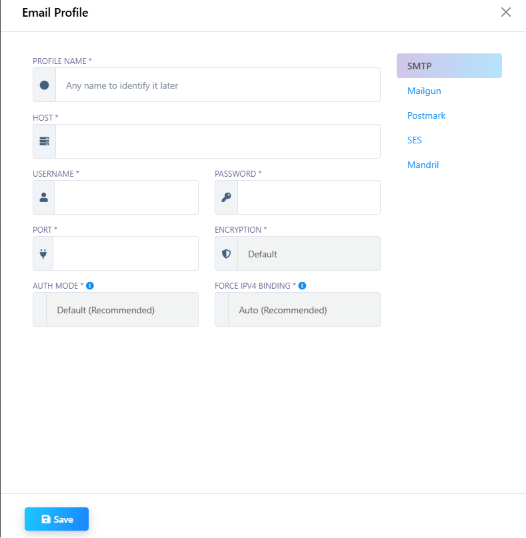
The SMTP fields
Your email provider (Zoho, in this example, or any other SMTP service) publishes these values in its own mail settings — you’re copying them across, not inventing them.1
Open Add Email Provider
From Email Integration, click New and pick SMTP as the
Provider Type.
2
Get your SMTP details from the provider
Log into your email provider’s settings (Zoho Mail, in this example) and copy its SMTP Host,
Port, and Username. If the provider requires an app password (Zoho does), generate one there
first — don’t reuse your normal mailbox password.
3
Fill in the form
Enter the Sender Name, Sender Email, SMTP Host, SMTP Port, SMTP Username, and SMTP Password,
then enable Use SSL/TLS if your provider requires encryption.
4
Click Save
The profile is now available to select anywhere Email Integration is used, e.g. the
Email tab in Bot Settings.
Frequently asked
How do I connect SMTP email with ChatSyncs?
How do I connect SMTP email with ChatSyncs?
Go to Email Integration, click New, and set Provider
Type to SMTP. Fill in Sender Name, Sender Email, SMTP Host, Port, Username, Password,
and enable SSL/TLS if your provider requires it, then click Save — see the field table
above for where each value comes from.
Can I use Gmail or Outlook's SMTP with ChatSyncs instead of Zoho?
Can I use Gmail or Outlook's SMTP with ChatSyncs instead of Zoho?
Yes — the same form works for any SMTP provider. Zoho is just the worked example here; swap
in the Host, Port, Username, and Password that Gmail, Outlook, or your hosting provider
publishes for SMTP access.
Where do I find my SMTP Host and Port?
Where do I find my SMTP Host and Port?
In your email provider’s own settings — most providers (Zoho, Gmail Workspace, Outlook, a
hosting company’s mail service) publish an SMTP Host, Port, and whether SSL or TLS is
required on a dedicated “SMTP settings” or “Mail client settings” page.
Should I use my normal email password for SMTP Password?
Should I use my normal email password for SMTP Password?
Only if your provider allows it. Many providers, including Zoho, require you to generate a
separate app password for SMTP access instead of your regular login password.
What port should I use?
What port should I use?
465 if your provider uses SSL, or 587 if it uses TLS — check which one your provider
documents, since using the wrong port is a common reason the connection fails silently.
Related Documentation
- Email Integration — connecting any email provider (SMTP, Mailgun, Postmark, SES, Mandrill) and what it’s used for.
- How Do I Send an Automatic Email from My Bot? — using a connected Email Integration profile inside a bot.