

Prerequisites
- A WhatsApp number connected to ChatSyncs — see Connect WhatsApp.
- Read Keyword Replies first to understand how the whole flow builder works — this guide only covers what’s specific to this project, not Keyword Replies itself.
- Read HTTP API first — this project’s core mechanic is exactly that page’s Order API example, with a bank balance lookup in place of an order lookup.
- A Service Request Custom Field must exist first — create it under Subscriber Manager. The customer’s phone number and name don’t need a Custom Field — they’re already built-in subscriber values.
- An n8n workflow, published and reachable at a Webhook URL, containing: a Webhook trigger node, a Google Sheets node, an IF node, a Switch node, and a Respond to Webhook node. Building and hosting this n8n workflow is outside ChatSyncs — this guide covers the ChatSyncs side and how the two systems hand off data to each other.
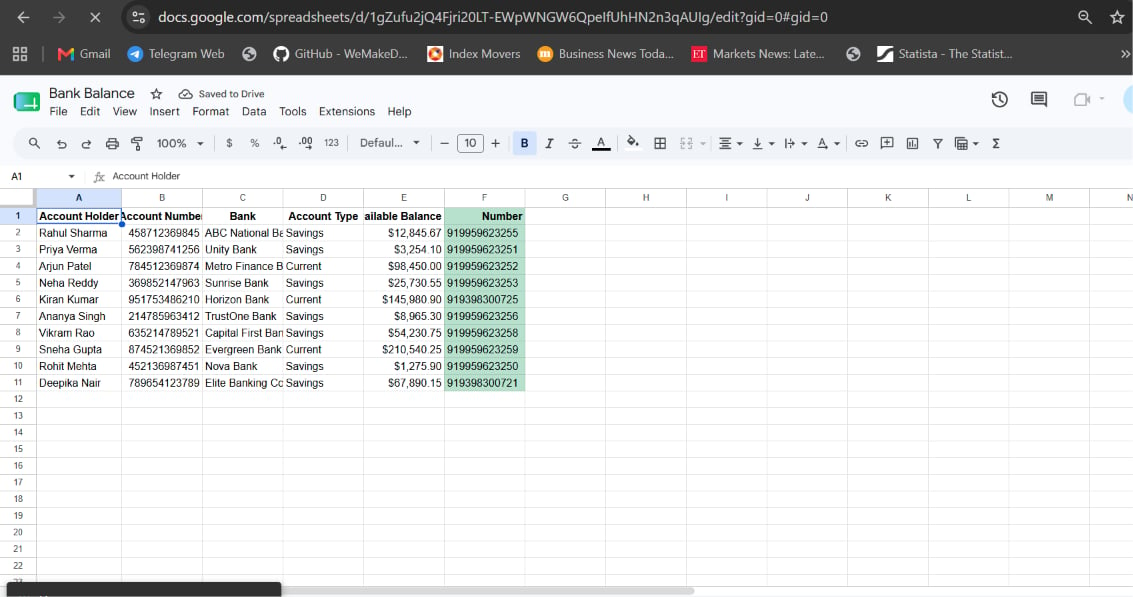
- A Google Sheet connected to that n8n workflow (not to ChatSyncs directly) with columns: Account Holder, Account Number, Bank, Account Type, Available Balance, Phone Number.
Implementation Guide
Step 1 — Create the Keyword Replies flow and welcome menu
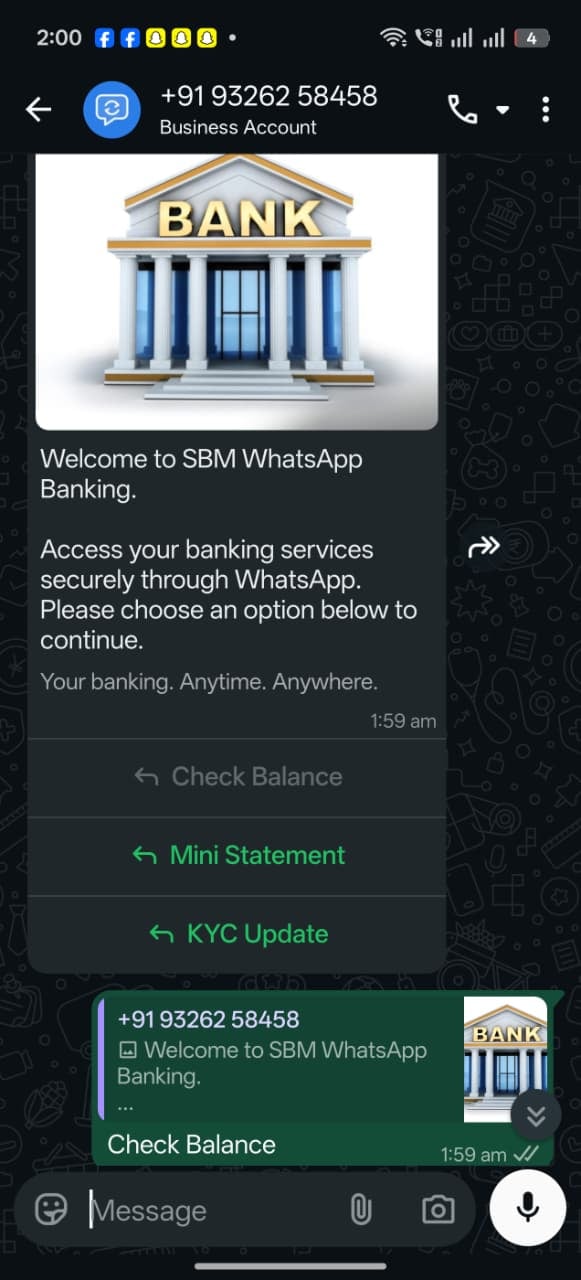
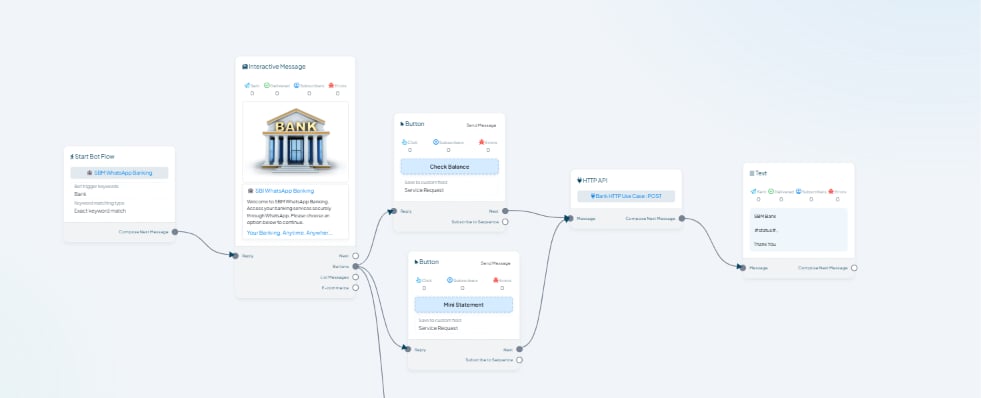
Objective: Greet the customer and offer a simple choice of service. Explanation: Keyword Replies is the flow builder this entire project runs on. An Interactive Message with Reply Buttons gives the customer a menu instead of requiring them to type a request in their own words. Actions to perform:- Open Keyword Replies and click Create.
- Set the Trigger Keywords to
Bank, with Exact keyword match. - Drag an Interactive Message block onto the canvas with a bank header image and body text,
e.g.
Welcome to SBM WhatsApp Banking. Access your banking services securely through WhatsApp. Please choose an option below to continue. - Add three Reply Buttons:
Check Balance,Mini Statement,KYC Update— the first two set Save to Custom Field toService Request, so whichever one is tapped is recorded as that subscriber’s requested service.
Step 2 — Configure the HTTP API call
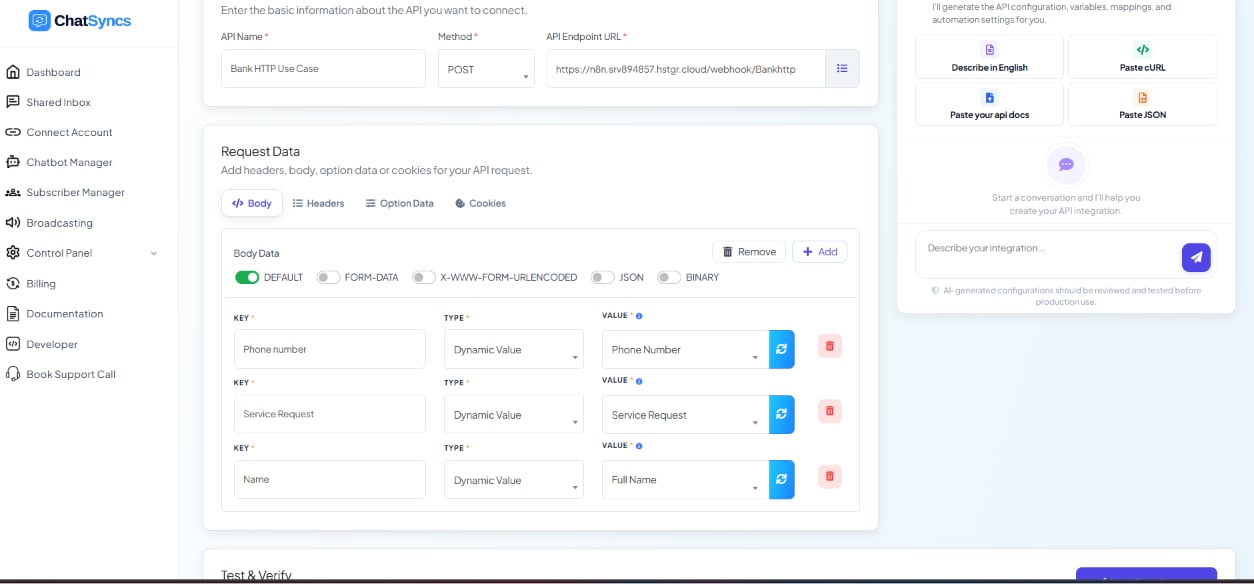
Objective: Send the customer’s identifying details to the bank’s backend the moment they tap either Check Balance or Mini Statement. Explanation: HTTP API connects a flow to any external REST endpoint — here, that endpoint is the n8n workflow’s Webhook trigger URL. The request body uses dynamic variables so the actual values sent depend on who’s asking. Actions to perform:-
After the buttons, connect an HTTP API step (named e.g.
Bank HTTP Use Case). -
Method:
POST. API Endpoint URL: the n8n workflow’s Webhook URL, e.g.https://<your-n8n-host>/webhook/Bankhttp. -
Body Data (Default key/value format — no need for raw JSON here): add three rows —
Phone Number and Full Name are the subscriber’s built-in values; Service Request is the Custom Field the two Reply Buttons just saved into.
Step 3 — n8n receives the request and looks up the customer
Objective: Find the customer’s account record from their phone number. Explanation: This part runs entirely inside n8n, outside ChatSyncs. The Webhook node is the entry point that receives ChatSyncs’s POST request; the Google Sheets node then searches for a row whose Phone Number column matches the incoming value. Here’s the complete n8n workflow canvas — Webhook → Get row(s) in sheet → If → Switch → three Respond to Webhook branches (found + Check Balance, found + Mini Statement, not found):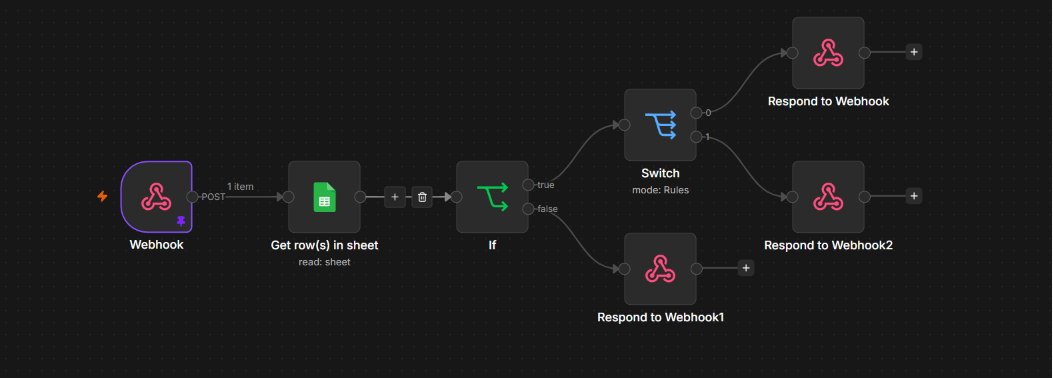
- Webhook node: receives the body sent by ChatSyncs’s HTTP API step.
- Google Sheets node: looks up a row in the connected sheet where the phone number column
equals the incoming
Phone numbervalue.
Step 4 — Validate the record and branch by service
Objective: Handle “customer not found” separately from a successful lookup, and route to the right response for the requested service. Explanation: An IF node checks whether the Google Sheets lookup returned a row. A Switch node then checks theService Request value — Check Balance or Mini Statement —
so one workflow already serves both services from the same welcome menu, instead of needing a
separate webhook per button.
Actions to perform (in n8n):
- IF node:
record found?→ true continues, false branches to an error response. - Switch node (true branch only): route on
Service Request— one branch forCheck Balance, one forMini Statement.
Step 5 — Respond to ChatSyncs with one pre-formatted field
Objective: Send the result back to ChatSyncs as a single ready-to-display string, not several separate values. Explanation: The Respond to Webhook node is what makes this call synchronous — the customer’s ChatSyncs flow is paused, waiting on this exact response, since HTTP API in ChatSyncs is a request/response call, not fire-and-forget. In the actual built flow, n8n does all of the branching and text formatting itself — success vs. not-found, Check Balance vs. Mini Statement — and hands ChatSyncs back one field,status, already containing the exact
lines the customer should see. ChatSyncs doesn’t branch on anything; it just drops that one
field into a fixed reply template.
Actions to perform (in n8n):
- On the Check Balance branch, Respond to Webhook with:
- On the Mini Statement branch, build the same account lines plus the transaction history
into that same field:
- On no match, put the error message in that same field instead:
{ "status": "We couldn't find an account linked to this number." }.
status field — already fully worded for whichever case applies.
Notes: Building the full message text in n8n instead of ChatSyncs means every future change
to the wording (a new line, a different greeting) only touches the n8n workflow — the ChatSyncs
flow and its template never need editing.
Step 6 — Drop the response into the reply template
Objective: Turn that onestatus field into the message the customer sees.
Explanation: No Condition block is needed on the ChatSyncs side — n8n already decided
what the text should say. ChatSyncs’s job is just to map the response and insert it into a
fixed Text Message template.
Actions to perform:
- Under Response Mapping, map the response’s
statusfield to a variable. - Add a Text Message step with a fixed wrapper and the mapped variable inserted where the
content goes, e.g.:
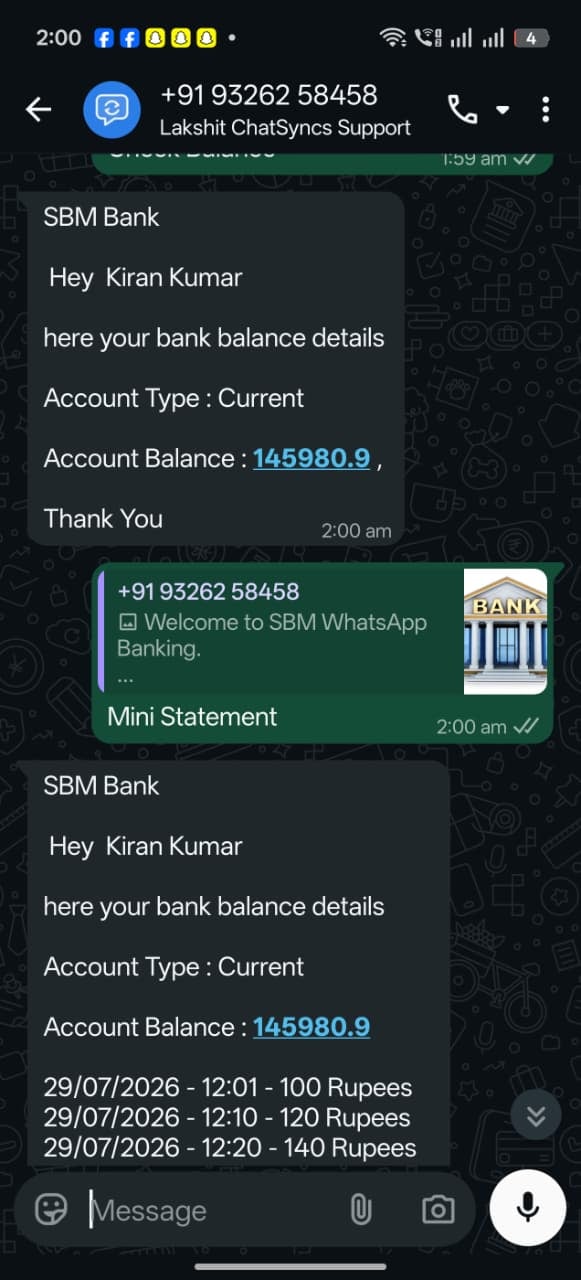
145980.9), not the
$145,980.90-formatted string shown in the Google Sheet cell — reading a sheet through an API
returns the cell’s raw value, not its display formatting. Format currency inside n8n’s status
string if the reply should show ₹ or thousands separators.
Download & test this flow
The exact flow used throughout this guide — Start Bot Flow, the Interactive Message, all three Reply Buttons, the HTTP API step, and the final Text reply — is available as a real exported flow file: Download bank-balance-inquiry-flow.txt Keyword Replies’ flow list has an Export Flow Data action (see Keyword Replies) that produces this exact file format. Use the matching import option in your own Keyword Replies list to load it in and test it against your own HTTP API / n8n setup, instead of rebuilding every block from these steps by hand.Features Used
Expected Result
- A customer taps Check Balance and receives their real account number, account type, and available balance within the same conversation, with no staff involved.
- A customer taps Mini Statement instead and gets routed through the same flow’s second branch, with no separate bot or webhook needed.
- A phone number with no matching bank record gets a clear “account not found” message instead of a silent failure or a generic bot error, regardless of which button was tapped.
- The same pattern is ready to extend to a third service (loan status, card status, etc.) by
adding another Reply Button and another Switch branch in n8n formatting its own
statustext — the ChatSyncs side needs no changes at all, since every branch reuses the same Response Mapping and the same fixed Text Message template.
FAQs
Does ChatSyncs store the customer's bank balance?
Does ChatSyncs store the customer's bank balance?
No — the balance lives in the bank’s own system (via n8n and Google Sheets in this example).
ChatSyncs only holds it in memory for the length of the conversation, as a mapped response
variable used to build the reply.
Why does this use HTTP API instead of Webhook Workflow?
Why does this use HTTP API instead of Webhook Workflow?
They run in opposite directions. Webhook Workflow is
inbound — an external system calls ChatSyncs to trigger a template send. This project is
outbound and synchronous — ChatSyncs calls out to n8n and waits for a reply within the
same flow, which is what HTTP API is built for.
What happens if n8n or Google Sheets is slow or unreachable?
What happens if n8n or Google Sheets is slow or unreachable?
The HTTP API call will time out or return no response. Always test the endpoint first with
Send Test Request (see the Warning on the HTTP
API page), and design the n8n workflow’s error path
to respond quickly rather than leaving ChatSyncs waiting.
Why does the Google Sheet need Phone Number stored as text?
Why does the Google Sheet need Phone Number stored as text?
Spreadsheet tools commonly reformat long numeric strings into scientific notation (e.g.
9.19E+11), which then won’t match the phone number ChatSyncs sends. Storing the column as
text avoids this — the same issue documented for Subscriber Manager CSV
imports.Does this handle both Check Balance and Mini Statement, or just balance?
Does this handle both Check Balance and Mini Statement, or just balance?
Both, already — the welcome menu has both Reply Buttons, both save into the same Service
Request Custom Field, and n8n’s Switch node routes each one to its own branch. The two
services share one HTTP API call, one webhook, and the exact same ChatSyncs reply template
— only the
status text n8n builds for each branch differs.Does Mini Statement return a real transaction list?
Does Mini Statement return a real transaction list?
Yes — the live bot replies with dated transaction lines (e.g.
29/07/2026 - 12:01 - 100 Rupees) in addition to the account details. The Google Sheet in Step 3 only holds
account-level fields, so those transaction lines come from a second data source wired into
n8n’s Mini Statement branch — that source isn’t part of the supplied screenshots, so its
exact shape (another sheet, a table, a separate API) isn’t covered here.Why does the balance show as 145980.9 instead of a formatted currency amount?
Why does the balance show as 145980.9 instead of a formatted currency amount?
Reading a Google Sheet cell through an API returns its raw underlying value, not its display
formatting — the sheet shows
$145,980.90 because of a currency format applied to the
cell, but the value handed to n8n (and then to ChatSyncs) is the plain number. Format it in
n8n or in the message text if the reply should show a currency symbol or thousands
separators.What is KYC Update — is it built the same way as the other two?
What is KYC Update — is it built the same way as the other two?
It’s a third Reply Button visible on the live welcome menu, but its backend isn’t part of
the supplied material — only Check Balance and Mini Statement were built out with HTTP API
and n8n. Wiring up KYC Update would follow the same pattern: its own Custom Field value and
its own branch in n8n’s Switch node.
Does the customer ever see n8n or Google Sheets?
Does the customer ever see n8n or Google Sheets?
No — from the customer’s side, this is a single WhatsApp conversation with two button taps.
n8n and Google Sheets are entirely behind the scenes, on the bank’s side of the integration.
Is this a real-time balance, or a cached/demo value?
Is this a real-time balance, or a cached/demo value?
That depends entirely on what’s connected to n8n’s Google Sheets node. In this example,
Google Sheets is described as a sample/demo data source — a production deployment would
point that same node at the bank’s actual core banking system or database instead.
Does this require any coding?
Does this require any coding?
Not on the ChatSyncs side — the flow, HTTP API step, and Response Mapping are all
configured by filling in forms on the Keyword Replies canvas. The n8n workflow does require
building the Webhook / Google Sheets / IF / Switch / Respond to Webhook nodes, which is
low-code rather than no-code.
Related Documentation
- Keyword Replies — the flow builder this project runs on.
- HTTP API — the outbound, synchronous integration this entire project is built around.
- Subscriber Manager — Custom Fields used in the request payload.
- Webhook Workflow — the inbound counterpart, for when an external system should trigger ChatSyncs instead of the other way around.
- Message Templates — for sending the balance reply as an approved template if the conversation is outside the 24-hour window.
Back to Business Problem
Start over from the beginning of this use case.