> ## Documentation Index
> Fetch the complete documentation index at: https://docs.chatsyncs.com/llms.txt
> Use this file to discover all available pages before exploring further.
# How to Send a Bulk WhatsApp Message to Many People in ChatSyncs
> How to message hundreds or thousands of WhatsApp subscribers at once — creating a broadcast campaign, targeting exactly who receives it, and checking delivery.
Say Rahul runs a clothing store with 500 WhatsApp subscribers and wants to tell all of them
about a weekend sale. Opening 500 separate chats isn't realistic — so instead, he creates one
**broadcast**: a single message that ChatSyncs sends to every subscriber he picks, all at once.
Every campaign he creates shows up in the WhatsApp Broadcasting list afterward, along with how
many people actually received and opened it.
## Before you start
* A WhatsApp Business Account connected to ChatSyncs, with an active phone number.
* A subscriber list already in ChatSyncs — import one first if you haven't, via
[How Do I Import Subscribers Using a CSV File?](/learn/chatsyncs-subscriber-manager/how-do-i-import-subscribers-using-a-csv-file-with-chatsyncs), [How Do I Import Subscribers from Google Sheets?](/learn/chatsyncs-subscriber-manager/how-do-i-import-subscribers-from-google-sheets-with-chatsyncs),
or [How Do I Add a Subscriber Manually?](/learn/chatsyncs-subscriber-manager/how-do-i-add-a-subscriber-manually-with-chatsyncs).
* An approved [Message Template](/learn/chatsyncs-message-templates/creating-a-whatsapp-message-template-in-chatsyncs), if you're sending an
**Anytime** broadcast (the type most people use). Meta has to approve a template before it
can be used, and that can take anywhere from a few minutes to a full day. **Example:** you
want to send a "Diwali Sale" message to 1,000 customers today, but your template still shows
**Pending** — the broadcast can't go out until Meta approves it, so it's faster to get the
template approved *before* you sit down to build the campaign, not while you're building it.
* Read [WhatsApp Rules: How to Never Get Banned](/learn/chatsyncs-overview/whatsapp-rules-how-to-never-get-banned) first — a
broadcast is exactly the kind of send that can hurt your quality rating if the audience didn't
opt in or isn't engaged. See [What WhatsApp API Pricing Really
Means](/learn/chatsyncs-overview/what-whatsapp-api-pricing-really-means) too, since every broadcast recipient outside their Customer
Service Window is a paid template send.
## Create a broadcast campaign
In the left-side menu of ChatSyncs, **Broadcasting** has its own button, separate from
**Chatbot Manager** and **Subscriber Manager** — it's not hidden inside either of those. Click
**Broadcasting** directly to get started.
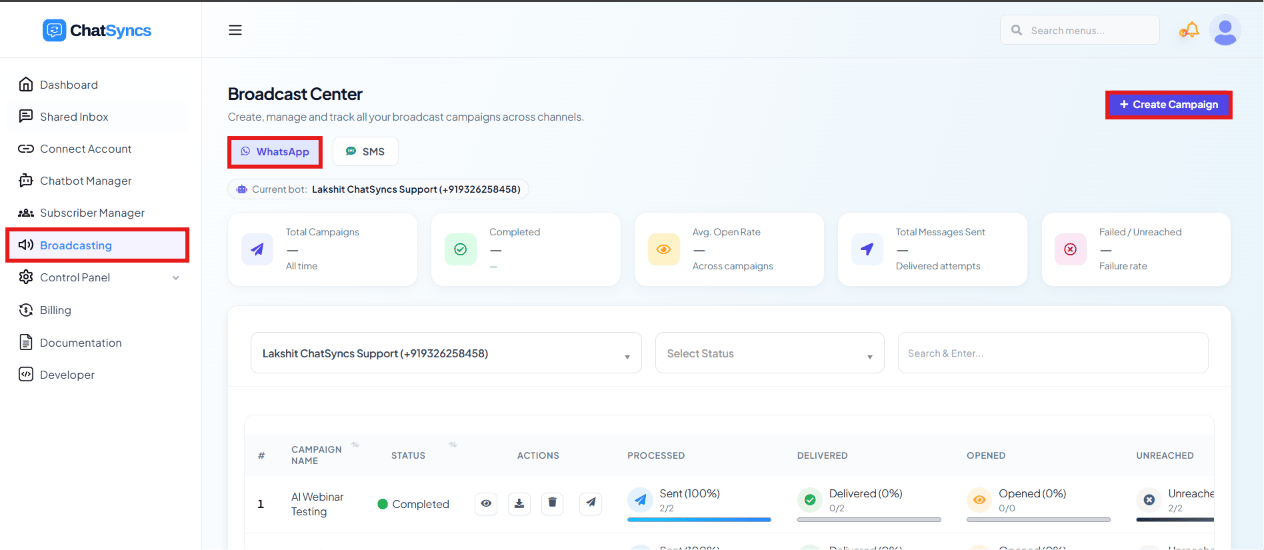 Select **Broadcasting** in the left navigation.
The **Broadcast Center** opens, with **WhatsApp** and **SMS** channel tabs and any campaigns
already created for the selected channel.
Click **Create Campaign** to start a new one.
Don't have any subscribers to broadcast to yet? See [How Do I Import Subscribers Using a CSV File?](/learn/chatsyncs-subscriber-manager/how-do-i-import-subscribers-using-a-csv-file-with-chatsyncs) before creating a campaign.
## Configure the campaign
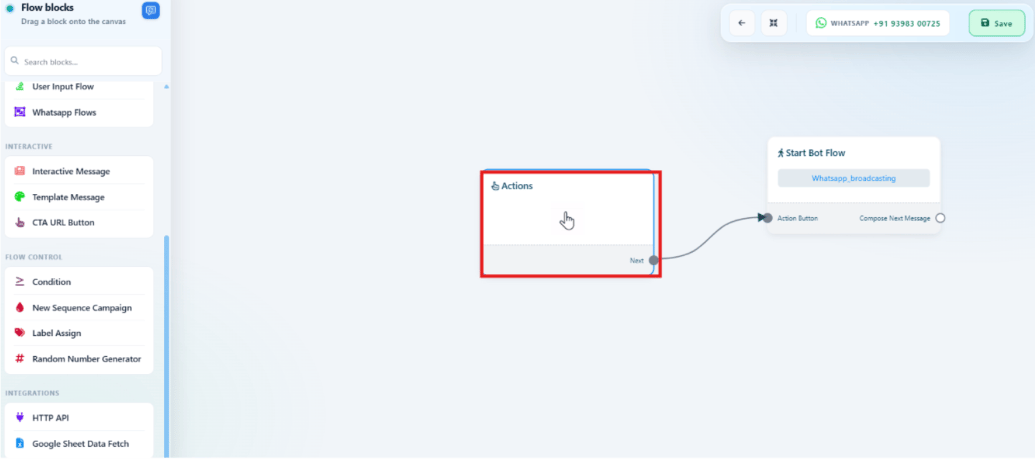
Clicking **Create Campaign** opens the broadcast canvas directly, with a **Start Bot Flow**
block already connected to an empty **Actions** block. Click that **Actions** block to open its
configuration panel:
Select **Broadcasting** in the left navigation.
The **Broadcast Center** opens, with **WhatsApp** and **SMS** channel tabs and any campaigns
already created for the selected channel.
Click **Create Campaign** to start a new one.
Don't have any subscribers to broadcast to yet? See [How Do I Import Subscribers Using a CSV File?](/learn/chatsyncs-subscriber-manager/how-do-i-import-subscribers-using-a-csv-file-with-chatsyncs) before creating a campaign.
## Configure the campaign
Clicking **Create Campaign** opens the broadcast canvas directly, with a **Start Bot Flow**
block already connected to an empty **Actions** block. Click that **Actions** block to open its
configuration panel:
 This opens the **Action Button** configuration panel set to **Broadcasting** — fill in the
campaign here:
This opens the **Action Button** configuration panel set to **Broadcasting** — fill in the
campaign here:
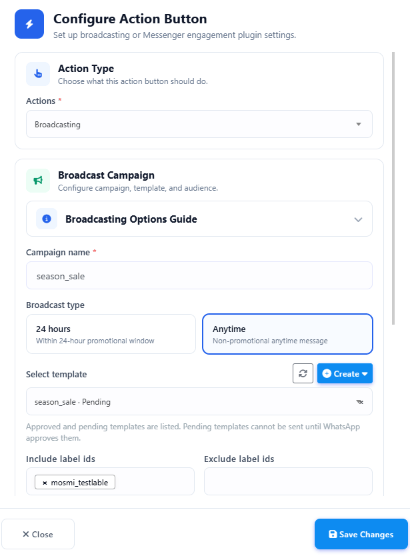 An internal name to identify the campaign, e.g. `Summer Promotion Campaign` or `season_sale`.
**24 Hours** sends only to subscribers currently inside the WhatsApp 24-hour customer
service window — regular messages, no template approval required. **Anytime** sends to all
selected subscribers regardless of window, but because some of them are outside it, only an
**approved WhatsApp template** can be used. See
[the 24-hour customer service window](/meta-api/messaging/24-hour-customer-service-window).
Pick an approved template from **Select Template**. This step only appears for **Anytime** —
inside a **24 Hours** broadcast you're free to send any message type (text, service/session
messages, etc.), so no template is required. Don't have one yet? Click **Create** right next
to the dropdown, or
[create a WhatsApp message template](/learn/chatsyncs-message-templates/creating-a-whatsapp-message-template-in-chatsyncs) first — either way, you
need an approved template before you can send an Anytime broadcast.
An internal name to identify the campaign, e.g. `Summer Promotion Campaign` or `season_sale`.
**24 Hours** sends only to subscribers currently inside the WhatsApp 24-hour customer
service window — regular messages, no template approval required. **Anytime** sends to all
selected subscribers regardless of window, but because some of them are outside it, only an
**approved WhatsApp template** can be used. See
[the 24-hour customer service window](/meta-api/messaging/24-hour-customer-service-window).
Pick an approved template from **Select Template**. This step only appears for **Anytime** —
inside a **24 Hours** broadcast you're free to send any message type (text, service/session
messages, etc.), so no template is required. Don't have one yet? Click **Create** right next
to the dropdown, or
[create a WhatsApp message template](/learn/chatsyncs-message-templates/creating-a-whatsapp-message-template-in-chatsyncs) first — either way, you
need an approved template before you can send an Anytime broadcast.
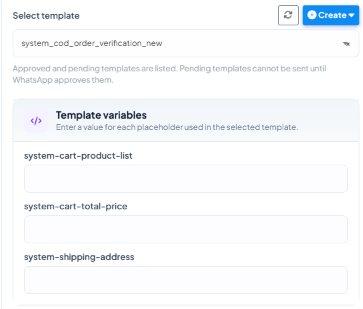
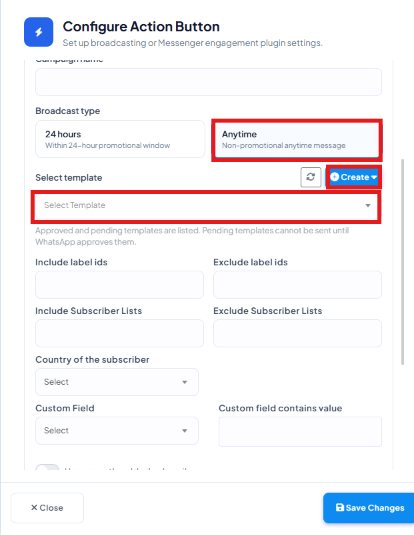 If the template you pick has variables — placeholder text, or a header image/video/document
— ChatSyncs asks for those values right below the dropdown:
If the template you pick has variables — placeholder text, or a header image/video/document
— ChatSyncs asks for those values right below the dropdown:
 **Include Label IDs** sends only to subscribers with that label (e.g. `Customers`, `Leads`,
`VIP Customers`). **Exclude Label IDs** skips subscribers with that label (e.g.
`Unsubscribed`, `Do Not Disturb`). Don't have a label yet?
[Create a label in Subscriber Manager](/learn/chatsyncs-subscriber-manager/how-do-i-manage-custom-fields-labels-and-lists-with-chatsyncs#create-a-label).
Only send to subscribers in a specific country, e.g. `India`.
Enable this to target only recently added subscribers — useful for welcome campaigns,
onboarding sequences, or new-lead engagement.
Auto-assign a label to every subscriber once the broadcast sends successfully — useful for
segmenting an audience, filtering future broadcasts, triggering automations, and tracking
campaign performance.
**Example:** a `Summer Sale` broadcast with **Assigned Label** set to `Summer_Sale` tags
every recipient — Rahul, Priya, Amit, and everyone else — with `Summer_Sale` the moment they
receive it, so you can target exactly that audience again later (e.g. a follow-up discount
reminder only to people who already saw the sale).
By default the campaign sends as soon as you finish building and save it. Toggle **Send
later** on to pick a future date and time instead — useful for holiday campaigns, product
launches, or timing the send to your audience's business hours.
**Include Label IDs** sends only to subscribers with that label (e.g. `Customers`, `Leads`,
`VIP Customers`). **Exclude Label IDs** skips subscribers with that label (e.g.
`Unsubscribed`, `Do Not Disturb`). Don't have a label yet?
[Create a label in Subscriber Manager](/learn/chatsyncs-subscriber-manager/how-do-i-manage-custom-fields-labels-and-lists-with-chatsyncs#create-a-label).
Only send to subscribers in a specific country, e.g. `India`.
Enable this to target only recently added subscribers — useful for welcome campaigns,
onboarding sequences, or new-lead engagement.
Auto-assign a label to every subscriber once the broadcast sends successfully — useful for
segmenting an audience, filtering future broadcasts, triggering automations, and tracking
campaign performance.
**Example:** a `Summer Sale` broadcast with **Assigned Label** set to `Summer_Sale` tags
every recipient — Rahul, Priya, Amit, and everyone else — with `Summer_Sale` the moment they
receive it, so you can target exactly that audience again later (e.g. a follow-up discount
reminder only to people who already saw the sale).
By default the campaign sends as soon as you finish building and save it. Toggle **Send
later** on to pick a future date and time instead — useful for holiday campaigns, product
launches, or timing the send to your audience's business hours.
 ## Filter by Custom Field
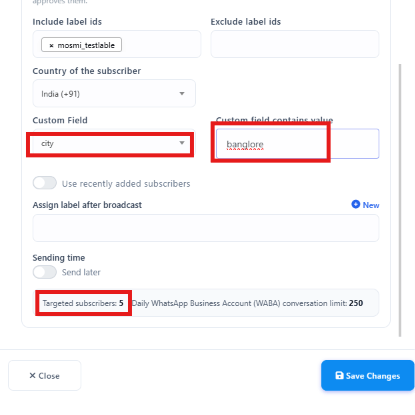
**Custom Field** and **Custom Field Contains Value** let you send a broadcast only to
subscribers who have a specific answer saved in a specific field. Think of it in two parts:
* **Custom Field** is the *category* — like asking "which box am I checking?" e.g. `Name`,
`City`, `Plan Type`.
* **Custom Field Contains Value** is the *answer* you're looking for inside that box — e.g. if
the field is `Name`, the value could be `Rahul`. If the field is `City`, the value could be
`Bangalore`.
So if you set **Custom Field = City** and **Custom Field Contains Value = Bangalore**, only
subscribers whose City is saved as Bangalore will receive the broadcast — everyone else is
skipped.
## Filter by Custom Field
**Custom Field** and **Custom Field Contains Value** let you send a broadcast only to
subscribers who have a specific answer saved in a specific field. Think of it in two parts:
* **Custom Field** is the *category* — like asking "which box am I checking?" e.g. `Name`,
`City`, `Plan Type`.
* **Custom Field Contains Value** is the *answer* you're looking for inside that box — e.g. if
the field is `Name`, the value could be `Rahul`. If the field is `City`, the value could be
`Bangalore`.
So if you set **Custom Field = City** and **Custom Field Contains Value = Bangalore**, only
subscribers whose City is saved as Bangalore will receive the broadcast — everyone else is
skipped.
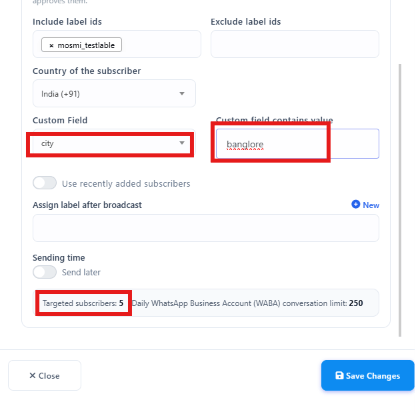 Notice **Targeted subscribers: 5** right below the filters — ChatSyncs counts the matches live,
so you can see exactly how many people will get the message before you send anything.
Don't have a custom field yet, like `City` or `Plan Type`?
[Create a custom field in Subscriber Manager](/learn/chatsyncs-subscriber-manager/how-do-i-manage-custom-fields-labels-and-lists-with-chatsyncs#custom-fields).
## Personalize the message for each subscriber
A broadcast doesn't have to read the same for everyone. The same custom fields you filter on
can also go *inside* the message, so every subscriber sees their own saved value — their name,
their city, their plan. In an **Anytime** broadcast the message is your template, so the
personalization goes into the template:
Every subscriber you target needs a value saved in that field, or that part of the message
sends blank. See
[how a custom field gets filled in](/learn/chatsyncs-subscriber-manager/how-do-i-manage-custom-fields-labels-and-lists-with-chatsyncs#how-a-custom-field-gets-filled-in) —
a CSV or Google Sheet import column, a Keyword Replies flow, or a form answer.
In the template's **Message Body**, click **Custom Fields** and pick the field — it's written
as `#field_name#`, e.g. `#city#`. The **Name** button inserts the subscriber's name. See
[Custom Fields, Variables, Name, and AI Rewrite](/learn/chatsyncs-message-templates/creating-a-whatsapp-message-template-in-chatsyncs#custom-fields-variables-name-and-ai-rewrite)
for every placeholder type, then submit the template for Meta's approval.
Once approved, choose it under **Select Template** in the campaign configuration above.
ChatSyncs fills in each subscriber's own value as it sends.
**Example:** Rahul's template body reads:
```text theme={null}
Hi #User-Name#, our weekend sale is now live at the #city# store!
```
| Subscriber | Saved `city` | What they receive |
| - | - | - |
| Priya | Bangalore | "Hi Priya, our weekend sale is now live at the Bangalore store!" |
| Amit | Mumbai | "Hi Amit, our weekend sale is now live at the Mumbai store!" |
Personalized messages also feel less like mass spam, so they tend to get fewer blocks and
reports — which protects your
[quality rating](/learn/chatsyncs-message-templates/understanding-whatsapp-quality-rating-in-chatsyncs).
A custom field holds a value that stays the same for that subscriber every time. For a value that
changes with every send — a price, an order number — use a Template Variable instead. See
[Template Variables vs Custom Variables](/learn/chatsyncs-message-templates/template-variables-vs-custom-variables-whats-the-difference-with-chatsyncs).
## Check your daily sending limit
Notice **Targeted subscribers: 5** right below the filters — ChatSyncs counts the matches live,
so you can see exactly how many people will get the message before you send anything.
Don't have a custom field yet, like `City` or `Plan Type`?
[Create a custom field in Subscriber Manager](/learn/chatsyncs-subscriber-manager/how-do-i-manage-custom-fields-labels-and-lists-with-chatsyncs#custom-fields).
## Personalize the message for each subscriber
A broadcast doesn't have to read the same for everyone. The same custom fields you filter on
can also go *inside* the message, so every subscriber sees their own saved value — their name,
their city, their plan. In an **Anytime** broadcast the message is your template, so the
personalization goes into the template:
Every subscriber you target needs a value saved in that field, or that part of the message
sends blank. See
[how a custom field gets filled in](/learn/chatsyncs-subscriber-manager/how-do-i-manage-custom-fields-labels-and-lists-with-chatsyncs#how-a-custom-field-gets-filled-in) —
a CSV or Google Sheet import column, a Keyword Replies flow, or a form answer.
In the template's **Message Body**, click **Custom Fields** and pick the field — it's written
as `#field_name#`, e.g. `#city#`. The **Name** button inserts the subscriber's name. See
[Custom Fields, Variables, Name, and AI Rewrite](/learn/chatsyncs-message-templates/creating-a-whatsapp-message-template-in-chatsyncs#custom-fields-variables-name-and-ai-rewrite)
for every placeholder type, then submit the template for Meta's approval.
Once approved, choose it under **Select Template** in the campaign configuration above.
ChatSyncs fills in each subscriber's own value as it sends.
**Example:** Rahul's template body reads:
```text theme={null}
Hi #User-Name#, our weekend sale is now live at the #city# store!
```
| Subscriber | Saved `city` | What they receive |
| - | - | - |
| Priya | Bangalore | "Hi Priya, our weekend sale is now live at the Bangalore store!" |
| Amit | Mumbai | "Hi Amit, our weekend sale is now live at the Mumbai store!" |
Personalized messages also feel less like mass spam, so they tend to get fewer blocks and
reports — which protects your
[quality rating](/learn/chatsyncs-message-templates/understanding-whatsapp-quality-rating-in-chatsyncs).
A custom field holds a value that stays the same for that subscriber every time. For a value that
changes with every send — a price, an order number — use a Template Variable instead. See
[Template Variables vs Custom Variables](/learn/chatsyncs-message-templates/template-variables-vs-custom-variables-whats-the-difference-with-chatsyncs).
## Check your daily sending limit
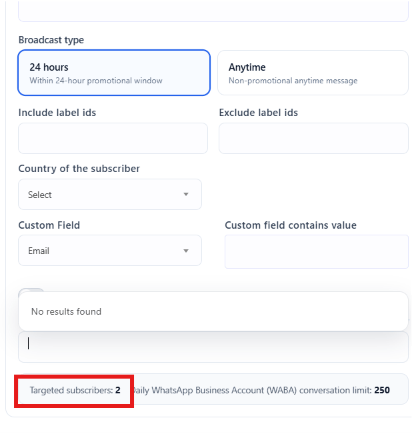 Right next to the **Targeted subscribers** count, a **Daily WhatsApp Business Account (WABA)
conversation limit** shows the maximum subscribers you're allowed to message per day. If your
targeted count is higher than this limit, only that many will actually be reached today — keep
an eye on both numbers before sending a **24 Hours** broadcast.
When a customer replies to a 24-hour broadcast, a new 24-hour window automatically opens —
letting you keep messaging them without an approved template. Including interactive buttons or
a clear call-to-action in the broadcast encourages replies, which refreshes the window and
reduces how often you need paid template messages.
## Build the broadcast message
Once every setting above is filled in, click **Save Changes** at the bottom of the Action Button
panel. The broadcast canvas opens right after:
Right next to the **Targeted subscribers** count, a **Daily WhatsApp Business Account (WABA)
conversation limit** shows the maximum subscribers you're allowed to message per day. If your
targeted count is higher than this limit, only that many will actually be reached today — keep
an eye on both numbers before sending a **24 Hours** broadcast.
When a customer replies to a 24-hour broadcast, a new 24-hour window automatically opens —
letting you keep messaging them without an approved template. Including interactive buttons or
a clear call-to-action in the broadcast encourages replies, which refreshes the window and
reduces how often you need paid template messages.
## Build the broadcast message
Once every setting above is filled in, click **Save Changes** at the bottom of the Action Button
panel. The broadcast canvas opens right after:
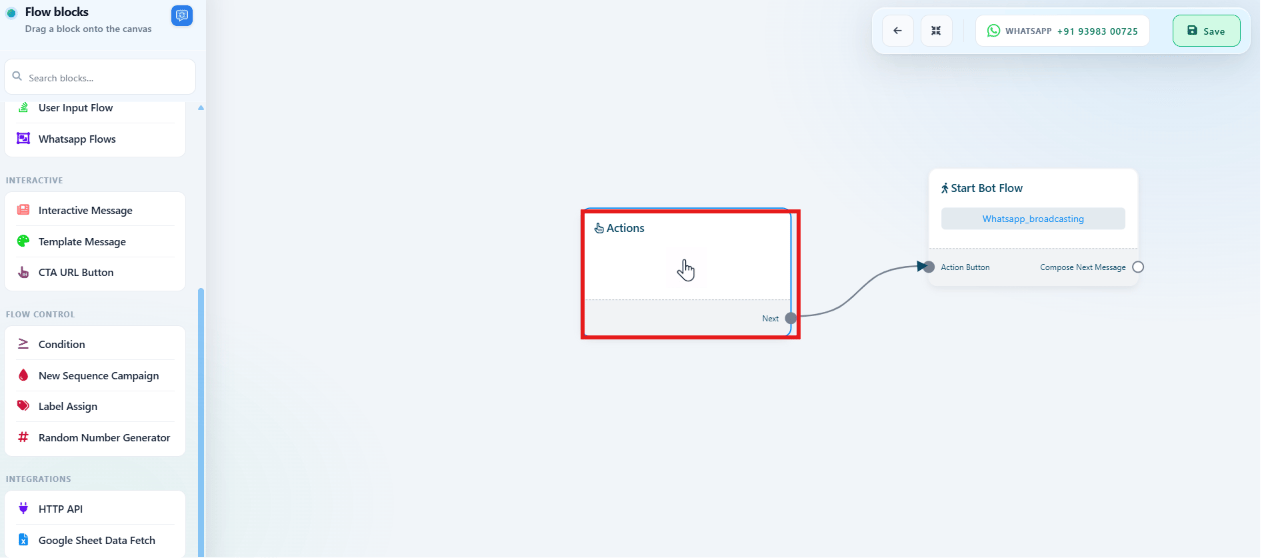 The canvas works just like the Keyword Replies builder. A **Start Bot Flow** block is already
connected to the **Actions: Broadcasting** block;
drag on more blocks to design what subscribers receive.
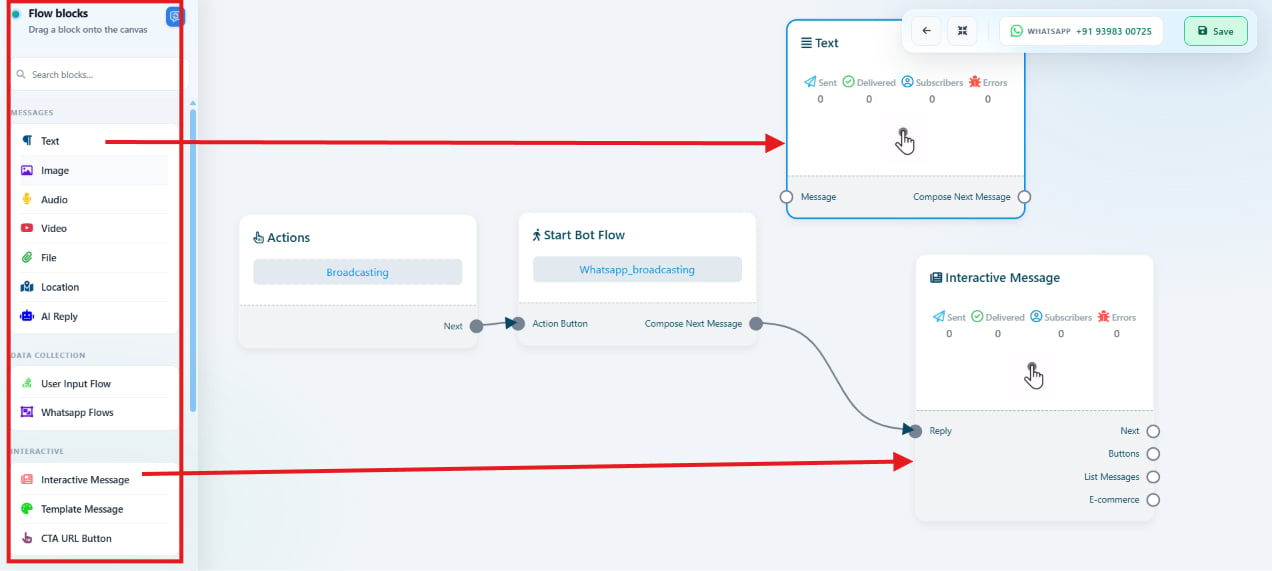
You can add the same component types available in Keyword Replies: Text, Images, Videos, Documents,
Audio Files, Interactive Buttons, Quick Replies, CTA/URL Buttons, Lists, Forms, Conditions,
Actions, and AI Responses. Drag blocks from the **Flow blocks** panel and connect them to design
the journey, for example:
The canvas works just like the Keyword Replies builder. A **Start Bot Flow** block is already
connected to the **Actions: Broadcasting** block;
drag on more blocks to design what subscribers receive.
You can add the same component types available in Keyword Replies: Text, Images, Videos, Documents,
Audio Files, Interactive Buttons, Quick Replies, CTA/URL Buttons, Lists, Forms, Conditions,
Actions, and AI Responses. Drag blocks from the **Flow blocks** panel and connect them to design
the journey, for example:
 ```
Broadcast Trigger
↓
Welcome Message
↓
Image
↓
Interactive Buttons
↓
Collect User Response
↓
Assign Label
↓
End Flow
```
## Monitor campaign statistics
Once a campaign is sent, the **WhatsApp Broadcasting** list shows its **Campaign Name**,
**Status** (Completed, Pending, Processing, etc.), **Scheduled At** time, and four metrics:
| Metric | Meaning | Example |
| - | - | - |
| **Processed** | Subscribers the system attempted to send to | `Sent (100%) — 11/11` |
| **Delivered** | Messages successfully delivered | `Delivered (64%) — 7/11` |
| **Opened** | Recipients who opened the delivered message | `Opened (43%) — 3/7` |
| **Unreached** | Subscribers who could not receive the message | `Unreached (27%) — 3/11` |
```
Broadcast Trigger
↓
Welcome Message
↓
Image
↓
Interactive Buttons
↓
Collect User Response
↓
Assign Label
↓
End Flow
```
## Monitor campaign statistics
Once a campaign is sent, the **WhatsApp Broadcasting** list shows its **Campaign Name**,
**Status** (Completed, Pending, Processing, etc.), **Scheduled At** time, and four metrics:
| Metric | Meaning | Example |
| - | - | - |
| **Processed** | Subscribers the system attempted to send to | `Sent (100%) — 11/11` |
| **Delivered** | Messages successfully delivered | `Delivered (64%) — 7/11` |
| **Opened** | Recipients who opened the delivered message | `Opened (43%) — 3/7` |
| **Unreached** | Subscribers who could not receive the message | `Unreached (27%) — 3/11` |
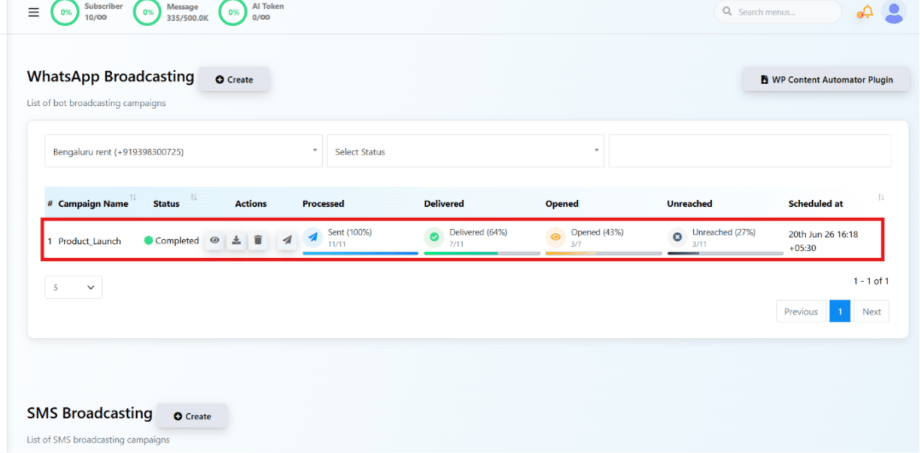 Unreached messages are usually caused by invalid phone numbers, the user not being on WhatsApp,
blocked accounts, or other delivery failures.
## Campaign actions
Unreached messages are usually caused by invalid phone numbers, the user not being on WhatsApp,
blocked accounts, or other delivery failures.
## Campaign actions
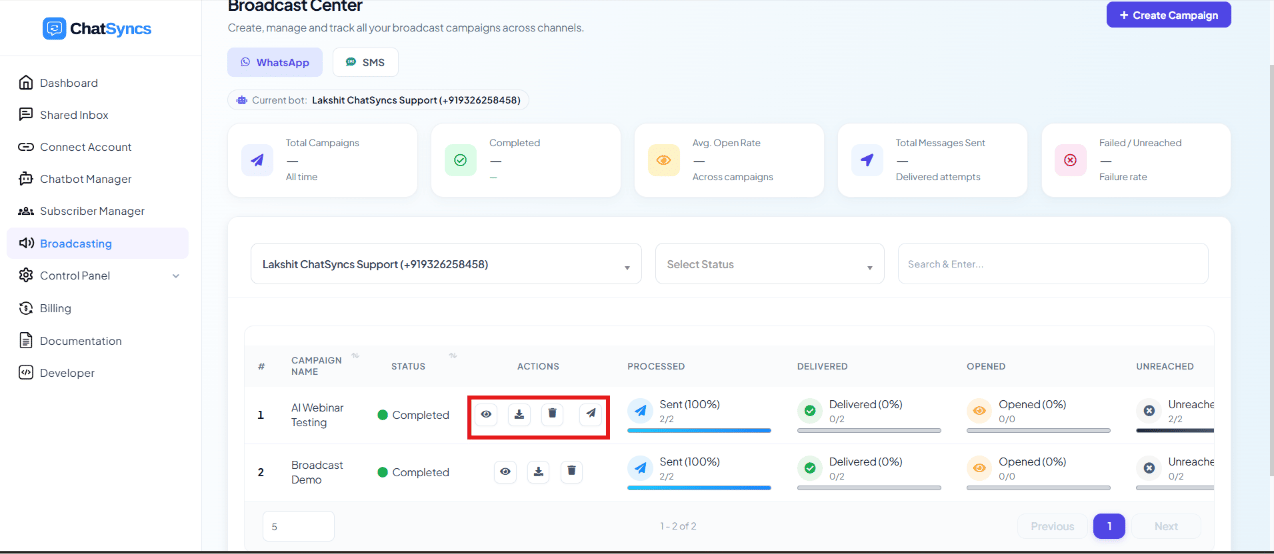 Each campaign row has action buttons:
* **View Report** — detailed broadcast statistics and recipient information.
* **Download Report** — exports the report as a CSV for analysis and record keeping.
* **Resend Failed Messages** — retries delivery for messages that failed, e.g. after correcting
invalid phone numbers.
* **Delete Campaign** — removes the campaign from the list.
**Example:** `Product_Launch` completed with Processed 11/11, Delivered 7/11, Opened 3/7,
Unreached 3/11. After fixing the numbers behind the 3 unreached sends, **Resend Failed
Messages** retries delivery to just those subscribers.
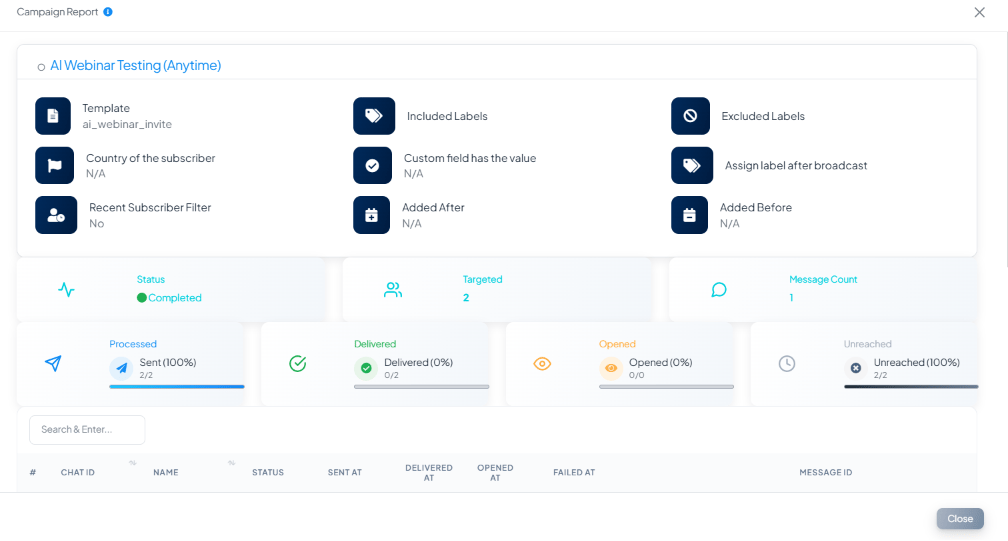
Clicking **View Report** opens the campaign's full detail — the audience filters it was sent
with (Template, Included/Excluded Labels, Country, Custom Field, Assign Label After Broadcast,
Added Before/After), plus its Status, Targeted count, Message Count, and the same
Processed/Delivered/Opened/Unreached breakdown shown on the list.
Each campaign row has action buttons:
* **View Report** — detailed broadcast statistics and recipient information.
* **Download Report** — exports the report as a CSV for analysis and record keeping.
* **Resend Failed Messages** — retries delivery for messages that failed, e.g. after correcting
invalid phone numbers.
* **Delete Campaign** — removes the campaign from the list.
**Example:** `Product_Launch` completed with Processed 11/11, Delivered 7/11, Opened 3/7,
Unreached 3/11. After fixing the numbers behind the 3 unreached sends, **Resend Failed
Messages** retries delivery to just those subscribers.
Clicking **View Report** opens the campaign's full detail — the audience filters it was sent
with (Template, Included/Excluded Labels, Country, Custom Field, Assign Label After Broadcast,
Added Before/After), plus its Status, Targeted count, Message Count, and the same
Processed/Delivered/Opened/Unreached breakdown shown on the list.
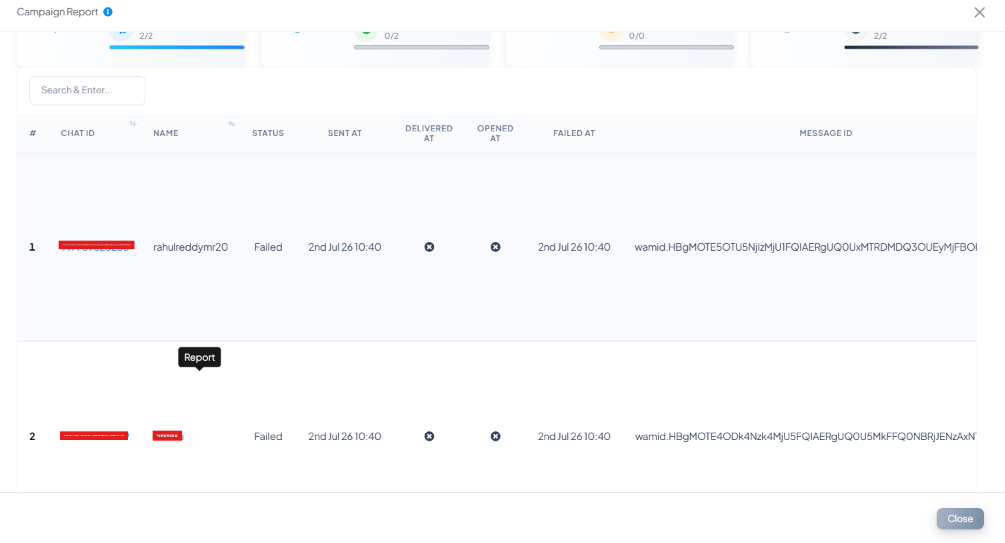
 Scrolling down shows every individual recipient — Chat ID, Name, Status, Sent At, Delivered At,
Opened At, Failed At, and Message ID — so you can see exactly who received the message and who
didn't.
Scrolling down shows every individual recipient — Chat ID, Name, Status, Sent At, Delivered At,
Opened At, Failed At, and Message ID — so you can see exactly who received the message and who
didn't.
 WhatsApp charges for template messages based on the template's category (Marketing, Utility, or
Authentication) and the recipient's country — an Anytime broadcast always uses a template, so
it's always a paid send, not something covered by a free monthly quota. **Example:** you start
an Anytime broadcast to 1,000 customers with no payment method on file — the broadcast can stop
partway through instead of finishing. Add a card before you send, so this doesn't happen: [How
to Add Payment Method for WhatsApp API
Billing](/learn/chatsyncs-setup-and-configuration/how-to-add-payment-method-for-whatsapp-api-billing).
## Tips for successful broadcasts
* **Start small on your first send.** Target 100–200 subscribers first rather than your whole
list, then check your [quality rating](/learn/chatsyncs-message-templates/understanding-whatsapp-quality-rating-in-chatsyncs) a few hours later
before scaling up to the rest.
* **Don't broadcast to cold lists.** Contacts who never opted in or haven't interacted with your
business are far more likely to block or report you — that damages your quality rating and can
shrink your daily messaging limit.
* **Time it to your audience, not yours.** Send during business hours in the *recipient's*
timezone — messages that land at odd hours get more blocks.
* **Monitor results after every send.** Check **Processed / Delivered / Opened / Unreached** on
the campaign row. If blocks or Unreached are unusually high, pause and review your targeting
before sending the next one.
* **Know your daily limit before you send.** Your WhatsApp Business Account's daily conversation
limit caps how many subscribers can actually be reached — see
[Understanding WhatsApp Quality Rating](/learn/chatsyncs-message-templates/understanding-whatsapp-quality-rating-in-chatsyncs) for how quality rating
affects that limit over time.
**Example:** A store's first-ever broadcast goes to 150 subscribers labeled `Newsletter_Optin`
(people who explicitly opted in) rather than all 5,000 imported contacts. Delivered comes back
at 96% with zero blocks — a strong signal it's safe to broadcast to the full list next time.
## Frequently asked
Go to **Broadcasting → Create Campaign**, configure a campaign name, broadcast type, and
audience filters, then build the message on the canvas (just like a Keyword Replies flow) and
save. The campaign sends to every subscriber matching your filters.
Yes — in the campaign configuration panel, toggle **Sending time → Send later** on and pick
a future date and time. Leave it off and the campaign sends as soon as you finish building
and save it.
**24 Hours** only reaches subscribers currently inside the WhatsApp 24-hour customer service
window and can send regular messages with no template approval needed. **Anytime** reaches
everyone you select regardless of window, but because some recipients are outside it, it
requires an **approved WhatsApp template** — [build one in Message
Templates](/learn/chatsyncs-message-templates/creating-a-whatsapp-message-template-in-chatsyncs) if you don't have one yet.
Check the **Unreached** statistic on the campaign — common causes are invalid phone numbers,
the subscriber not being on WhatsApp, blocked accounts, or other delivery failures. Fix the
underlying issue (e.g. correct the number) and use **Resend Failed Messages** to retry.
Yes — use **Include Label IDs** for segments like VIP Customers, **Exclude Label IDs** to
skip segments like Unsubscribed, **Country of the Subscriber** to filter by location, or
**Custom Field** + **Custom Field Contains Value** to filter on a chatbot custom field such
as Plan Type.
Yes — insert custom fields (e.g. `#city#`) or the subscriber's name into the template's
Message Body, then pick that template for the broadcast. Each subscriber receives their own
saved value; if a field is empty for someone, that part sends blank. See
[Personalize the message for each subscriber](#personalize-the-message-for-each-subscriber).
**Custom Field** is which category you're checking, e.g. `City`. **Custom Field Contains
Value** is the specific answer you want inside that category, e.g. `Bangalore`. Together,
Custom Field = `City` and Value = `Bangalore` sends the broadcast only to subscribers whose
City is saved as Bangalore.
Click **View Report** on that campaign's row in the Broadcast Center list — it shows the
audience filters it was sent with, overall Processed/Delivered/Opened/Unreached stats, and a
recipient-by-recipient breakdown with each subscriber's delivery status and message ID.
No — send your first broadcast to a small, opted-in segment (100–200 subscribers) and check
your quality rating a few hours later. Broadcasting to a large, cold, or unengaged list risks
blocks and reports that hurt your ability to send in the future.
During business hours in your audience's timezone, not yours — messages that land late at
night or very early get more blocks and lower engagement.
* **Anytime broadcasts require an approved template** — Meta blocks unapproved templates and
plain text sent outside the 24-hour window. See [how to create a
template](/learn/chatsyncs-message-templates/creating-a-whatsapp-message-template-in-chatsyncs) if you don't have one yet.
* **The Daily WABA conversation limit caps how many subscribers can actually be reached**, even
if your audience filters match more than that — check the live **Targeted subscribers** count
against the daily limit before sending a 24-Hours broadcast.
* **Unreached subscribers aren't automatically retried** — use **Resend Failed Messages** after
fixing the underlying issue (e.g. an invalid number).
This documentation is built and hosted on [Mintlify](https://mintlify.com), a developer documentation platform.
WhatsApp charges for template messages based on the template's category (Marketing, Utility, or
Authentication) and the recipient's country — an Anytime broadcast always uses a template, so
it's always a paid send, not something covered by a free monthly quota. **Example:** you start
an Anytime broadcast to 1,000 customers with no payment method on file — the broadcast can stop
partway through instead of finishing. Add a card before you send, so this doesn't happen: [How
to Add Payment Method for WhatsApp API
Billing](/learn/chatsyncs-setup-and-configuration/how-to-add-payment-method-for-whatsapp-api-billing).
## Tips for successful broadcasts
* **Start small on your first send.** Target 100–200 subscribers first rather than your whole
list, then check your [quality rating](/learn/chatsyncs-message-templates/understanding-whatsapp-quality-rating-in-chatsyncs) a few hours later
before scaling up to the rest.
* **Don't broadcast to cold lists.** Contacts who never opted in or haven't interacted with your
business are far more likely to block or report you — that damages your quality rating and can
shrink your daily messaging limit.
* **Time it to your audience, not yours.** Send during business hours in the *recipient's*
timezone — messages that land at odd hours get more blocks.
* **Monitor results after every send.** Check **Processed / Delivered / Opened / Unreached** on
the campaign row. If blocks or Unreached are unusually high, pause and review your targeting
before sending the next one.
* **Know your daily limit before you send.** Your WhatsApp Business Account's daily conversation
limit caps how many subscribers can actually be reached — see
[Understanding WhatsApp Quality Rating](/learn/chatsyncs-message-templates/understanding-whatsapp-quality-rating-in-chatsyncs) for how quality rating
affects that limit over time.
**Example:** A store's first-ever broadcast goes to 150 subscribers labeled `Newsletter_Optin`
(people who explicitly opted in) rather than all 5,000 imported contacts. Delivered comes back
at 96% with zero blocks — a strong signal it's safe to broadcast to the full list next time.
## Frequently asked
Go to **Broadcasting → Create Campaign**, configure a campaign name, broadcast type, and
audience filters, then build the message on the canvas (just like a Keyword Replies flow) and
save. The campaign sends to every subscriber matching your filters.
Yes — in the campaign configuration panel, toggle **Sending time → Send later** on and pick
a future date and time. Leave it off and the campaign sends as soon as you finish building
and save it.
**24 Hours** only reaches subscribers currently inside the WhatsApp 24-hour customer service
window and can send regular messages with no template approval needed. **Anytime** reaches
everyone you select regardless of window, but because some recipients are outside it, it
requires an **approved WhatsApp template** — [build one in Message
Templates](/learn/chatsyncs-message-templates/creating-a-whatsapp-message-template-in-chatsyncs) if you don't have one yet.
Check the **Unreached** statistic on the campaign — common causes are invalid phone numbers,
the subscriber not being on WhatsApp, blocked accounts, or other delivery failures. Fix the
underlying issue (e.g. correct the number) and use **Resend Failed Messages** to retry.
Yes — use **Include Label IDs** for segments like VIP Customers, **Exclude Label IDs** to
skip segments like Unsubscribed, **Country of the Subscriber** to filter by location, or
**Custom Field** + **Custom Field Contains Value** to filter on a chatbot custom field such
as Plan Type.
Yes — insert custom fields (e.g. `#city#`) or the subscriber's name into the template's
Message Body, then pick that template for the broadcast. Each subscriber receives their own
saved value; if a field is empty for someone, that part sends blank. See
[Personalize the message for each subscriber](#personalize-the-message-for-each-subscriber).
**Custom Field** is which category you're checking, e.g. `City`. **Custom Field Contains
Value** is the specific answer you want inside that category, e.g. `Bangalore`. Together,
Custom Field = `City` and Value = `Bangalore` sends the broadcast only to subscribers whose
City is saved as Bangalore.
Click **View Report** on that campaign's row in the Broadcast Center list — it shows the
audience filters it was sent with, overall Processed/Delivered/Opened/Unreached stats, and a
recipient-by-recipient breakdown with each subscriber's delivery status and message ID.
No — send your first broadcast to a small, opted-in segment (100–200 subscribers) and check
your quality rating a few hours later. Broadcasting to a large, cold, or unengaged list risks
blocks and reports that hurt your ability to send in the future.
During business hours in your audience's timezone, not yours — messages that land late at
night or very early get more blocks and lower engagement.
* **Anytime broadcasts require an approved template** — Meta blocks unapproved templates and
plain text sent outside the 24-hour window. See [how to create a
template](/learn/chatsyncs-message-templates/creating-a-whatsapp-message-template-in-chatsyncs) if you don't have one yet.
* **The Daily WABA conversation limit caps how many subscribers can actually be reached**, even
if your audience filters match more than that — check the live **Targeted subscribers** count
against the daily limit before sending a 24-Hours broadcast.
* **Unreached subscribers aren't automatically retried** — use **Resend Failed Messages** after
fixing the underlying issue (e.g. an invalid number).
This documentation is built and hosted on [Mintlify](https://mintlify.com), a developer documentation platform.